
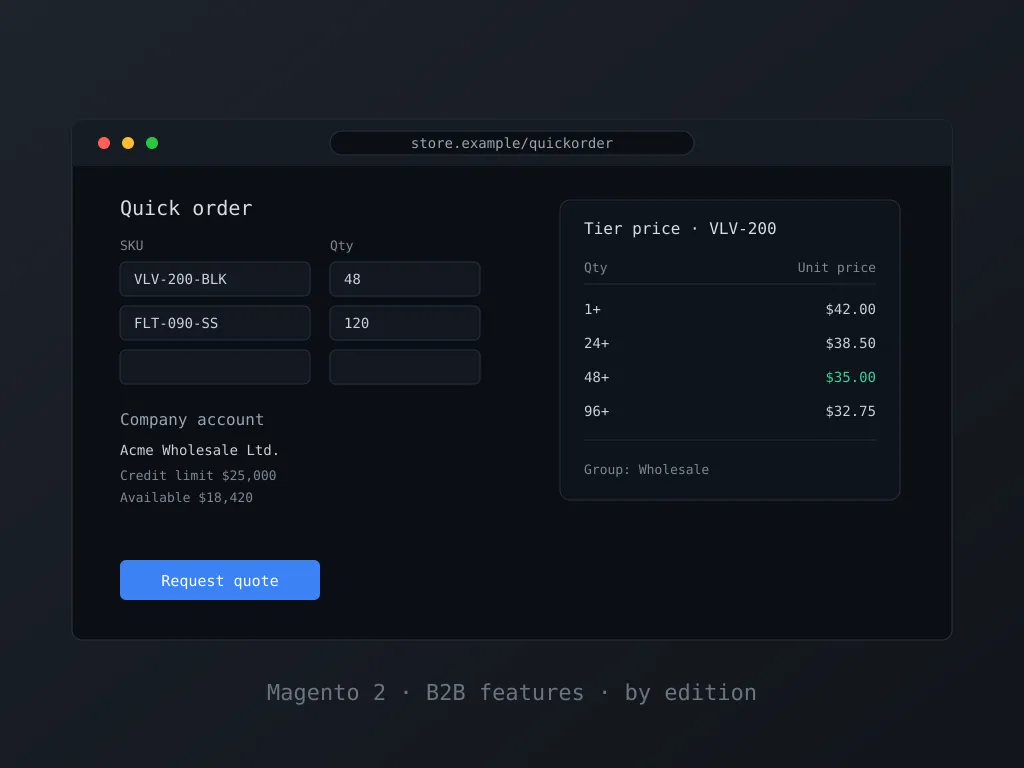
Magento B2B features depend on the edition. The B2B module ships only with Adobe Commerce: company accounts, shared catalogs, negotiable quotes, purchase order approvals, requisition lists and quick order. Magento Open Source has none of them built in. It still covers customer groups, group and tier prices, minimum order quantities and offline payment methods, and many wholesale stores need nothing more.
For a B2B store, the bigger job is usually the integration. Customer prices, credit limits and stock per warehouse live in the ERP, and the store has to show the same numbers.
What the Adobe Commerce B2B module adds
Adobe ships B2B as the magento/extension-b2b extension, which installs on Adobe Commerce only.
Its main features, from Adobe’s B2B introduction:
- Company accounts. Several buyers from one company share an account. The company admin builds divisions and users, and gives each role its own permissions for ordering, quoting and credit.
- Company credit. Companies can pay on account against a credit line that the merchant sets.
- Shared catalogs. Custom prices per product for different companies. Shared catalogs need company accounts.
- Negotiable quotes. A buyer requests a quote from the cart, or a seller starts one in the admin. Both sides change items, quantities and discounts until they agree.
- Purchase order approvals. Orders become purchase orders that go through approval rules set per company role.
- Requisition lists. Saved lists of products a buyer orders often, added to the cart in one step.
- Quick order. Logged-in buyers add products by SKU or name without browsing the catalog.
Every feature in this list depends on the Adobe Commerce licence.
What Magento Open Source already covers
Magento Open Source has the building blocks of a wholesale store in its core code:
- Customer groups. Put wholesale buyers in their own group, apart from retail customers. Prices, tax classes and catalog price rules follow the group.
- Group prices. Set a separate price per product for each customer group.
- Tier prices. Lower the unit price from a set quantity, for one group or for all. With tiers at 24 and 48 units, a cart of 30 units gets the 24-unit price.
- Minimum and maximum order quantities. Set the smallest quantity a customer can add to the cart per customer group, and a maximum for everyone.
- Offline payment methods. Purchase order, check or money order, bank transfer and cash on delivery all come with the core
OfflinePaymentsmodule.
A distributor with one price list per group, quantity discounts and payment by bank transfer runs on Open Source as it is.
Closing the gap on Open Source
Some stores need one or two B2B features without the rest. There are two routes:
- Extensions. Third-party extensions add features such as request-a-quote or quick order to Open Source. Pick focused modules and test them together on staging, because extensions that each change the cart and checkout can conflict.
- Custom work. A request-a-quote form tied to your sales process is often a small module. So is quick order against your own SKU rules. Custom work fits your workflow and adds only the code you use.
Compare the total with the Adobe Commerce licence before you commit. Three or four B2B extensions plus the work to keep them compatible on every upgrade adds up. When you need most of the B2B module, the licence can cost less than rebuilding it piece by piece.
The integration side of Magento B2B
B2B buyers expect the prices, credit and stock their account manager quotes them. That data lives in the ERP, so a Magento 2 B2B store is only as good as its ERP integration:
- Customer-specific prices. The ERP holds price lists and contract prices per customer. The integration maps them to customer groups, group prices or shared catalogs.
- Credit limits. The ERP owns the credit line. The integration pushes the limit and open balance to the store, so buyers see what they can spend.
- Stock per warehouse. Inventory sources in Magento follow the ERP’s warehouse stock, so buyers see real availability per location.
- Orders back to the ERP. Orders, including purchase order numbers, flow to the ERP for fulfilment and invoicing.
We build these connections for SAP, NetSuite and other ERPs. See our eCommerce integration service for how a project runs.
Magento B2B compared with Shopify
Shopify Plus includes B2B with unlimited catalogs. Since 2026, the lower Shopify plans also include basic B2B with up to 3 catalogs (Shopify Help Center). For a store with a few wholesale price lists and standard products, that can be enough.
Magento fits when B2B depends on ERP-driven prices per customer, complex products or approval flows that apps can’t express. Our Magento vs Shopify comparison covers the wider trade-off.
Where to start
List the B2B features your buyers use today, and mark the ones Open Source already covers. If the gaps are one or two features, extensions or custom work close them. If you need most of the B2B module, price the Adobe Commerce licence against the rebuild. In both cases, plan the ERP integration first, because it decides what buyers see.
Tell us about your B2B setup and we’ll map which parts need an extension, custom work or an integration.
References
- Adobe Commerce docs: Introduction to Adobe Commerce B2B
- Adobe Commerce docs: Install the Adobe Commerce B2B extension
- Magento Open Source on GitHub: OfflinePayments module
- Shopify Help Center: B2B plan features
Frequently asked questions
Magento B2B
Does Magento Open Source have B2B features?
Not the B2B module. Company accounts, shared catalogs, negotiable quotes, purchase order approvals, requisition lists and quick order come with the Adobe Commerce B2B extension, which installs only on Adobe Commerce. Magento Open Source still has customer groups, group and tier prices, minimum order quantities and offline payment methods, which cover many wholesale stores.
How much does Adobe Commerce B2B cost?
The B2B extension installs only on Adobe Commerce, so its cost is the Adobe Commerce licence. Get a quote from Adobe, then compare it with the cost of building only the B2B features you need on Magento Open Source with extensions or custom work.
Can Magento do wholesale pricing?
Yes, on both editions. Put wholesale buyers in their own customer group, then set group prices and tier prices for that group. Tier prices give quantity discounts, such as a lower unit price from 24 units. Adobe Commerce adds shared catalogs for custom prices per company.
How do tier prices work in Magento 2?
A tier price is a lower unit price from a set quantity, for one customer group or all groups. The highest tier the cart quantity reaches applies. With tiers at 5 and 10 units, a cart of 9 units gets the 5-unit price and a cart of 10 gets the 10-unit price.
Can Magento take ERP prices and credit limits for B2B customers?
Yes, through an integration. The ERP stays the source of customer-specific prices, credit limits and stock per warehouse, and the integration syncs them to Magento customer groups, prices and inventory sources. Adobe Commerce adds company credit, which an integration can keep in step with the ERP.